Monthly Archives: August 2008

Skating

There can’t be many things more fun than going into a freezing cold skating rink on a hot August day.  Skating was one of Antonia’s educational disasters, and it’s taken her this long to get back into it.  I was glad to see that she at least remembered all that she had managed to learn.  She took skating classes over a year ago, and started out with great enthusiasm having waited (and skated with us) for several years.

Sadly the class did not suit her at all.  The teacher barked at the children constantly, but thought it would make her class fun if she introduced competitive games.  Antonia skated more and more stiffly and defensively.  The last nail in the coffin was when we realised that the whole of the final term would be spent preparing for a huge show.  I couldn’t imagine our daughter performing at all in front of several hundred people.  If anything went wrong at all, I suspect she would freeze or collapse in hysterics.  In any case we weren’t interested in her having that kind of learning experience.  We rather hoped she would learn to skate, and it became clear that learning was over for the year, and repetition was about to set in.  Worse still, the teachers didn’t have the show planned out, and they spent the first couple of lessons in a huddle in a corner of the rink.  Left with not much to do and a tiny area in which to do it, the kids resorted to the type of entertainment we so often find in playgrounds, for the same reasons: teasing, forming of cliques and physical violence.  We quit at that point.

I hope we get to go skating again soon, because I have always enjoyed it.

Wild blueberries

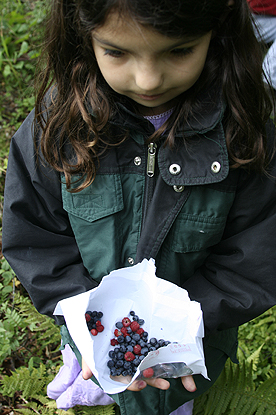
Today was one of those days where my nearest and dearest seemed determined to aggravate me so it was lucky that we found a nice patch of wild blueberries so that I could have something nice to talk about.  Also I found a fortuitous envelope in my pocket to put them in.

blueberry-picking.jpg

A sample of the conversation in the blueberry patch will give an idea of why I have been feeling aggravated:

N&D B (for Biggest): these blueberries are so small!  I don’t know how long we’re going to stay here picking blueberries.  I can’t believe how small they are!  We will never get enough to make a tart.  I just feel like we’re not really getting anywhere.  You and Antonia should come back with a bowl tomorrow. Do you think if we leave them they will get bigger?  How much longer are we going to pick berries for? This is going to be the tiniest tart ever! … ad infinitum

N&D A (for Adorable): oh, little berries, I’m going to eat you up!  Aren’t I going to eat them Mummy?  Look Mummy! I think there must be a thousand berries here, Mummy.  Do you think there are a thousand berries Mummy?  Look how many I’ve got Daddy! Would you like to hear my poem about berries, Mummy? Mummy, how many berries do you think we’ve picked?  We’ve got quite a lot of berries haven’t we Mummy?… ad infinitum

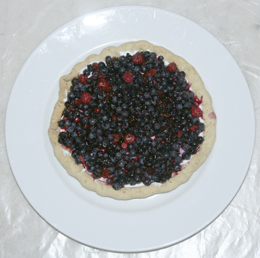
To really get the effect, you have to imagine them both saying stuff like that at once, without any regard to the fact that the other is speaking!  They do not always go on like that all day, I promise.  If they did, I think I would divorce one and send the other to school. They are both just overtired. Now, I am overtired from listening to them.  I did make the tart though, and it was delicious.

blueberry-tart.jpg

100 Species Challenge: pretty little white things

This week, I identified two of the smaller white flowers that are very common around here at the moment, at an altitude slightly above our house.

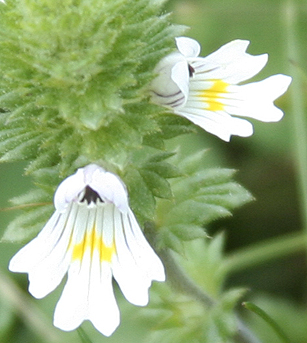
euphrasia-eyebright-euphraise.jpg

These are called Eyebright or Euphrasia, and the only thing I knew about them till now is that I see them every year and they look like pretty little faces.  They are very small.  Now I know that there are many kinds, and all the ones in my field guide are virtually indistinguishable.   They are semi-parasitic on grasses, so I seem to be making a thing of parasitic and semi-parasitic plants just now.  I had no idea until recently that such things existed.  They have been used in various herbal medicines.  They seem to prefer colder parts of the northern hemisphere, and highish altitudes where I live.

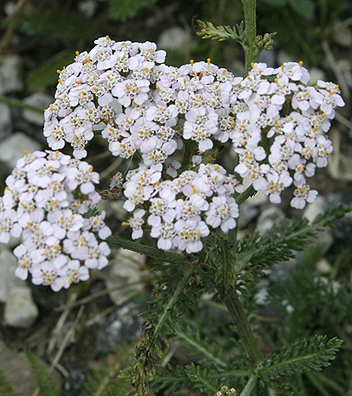
yarrow-achillee-millefeuille.jpg

This is Yarrow, and I know from observation that the petals vary from white to slightly pink, also the little clusters in the centre, that I suppose are the real flower can be larger or smaller, depending on the plant.  The Yarrow is easy to recognise because of the feathery leaves.  It is/was also a medicinal plant.

I also added Wood Sorrel to my list of known species because I suddenly remembered its name while the trefoil leaves were staring me in the face.  It flowers much earlier than this, with yellow flowers, but the leaves are easy to recognise: There are three of them, but they are more heart-shaped than clover, a fresher green, and live in the shade of the woods.

Too many books

I have to do something about our books.  There are too many of them.  Many of them are not very good, and the ones that are good are swamped.  Some of them are only useful at specific times, like travel guides for places we go to regularly.  There are lots of books that are good, which I would like to have but don’t (and don’t have space for them!)

The Social Services Visit

The social services ladies came today.  They were pretty professional, in that they asked the questions the law requires them to ask and nothing else.   They said the job of inspecting the three families in this division has been knocked around with nobody really knowing who should do it, until finally it landed on their desk.  They don’t know if they will ever be expected to do it again, or if they are the right people.

In retrospect, the only thing that is raising my hackles was them asking me if we ever thought of taking Antonia to a child psychologist.  The reason I’m upset is not because they asked it, specifically.  It’s to be expected, as it’s a standard solution here.  Believe it or not, lots of kids just don’t seem to be too happy in school!  I just feel I did a really bad job of explaining why I don’t agree with defining a child as in need of medical help because of it.  School is not so right and wonderful that only a psychologically abnormal child wouldn’t deal with it.  Not by a long way.  I’m still explaining it badly.  Oh well…

As far as I know, we will never hear anything back from this meeting.  It is just an information collecting exercise.

Scheduling

Today, I got the academic year planner for 2008-9 and began the task of filling in the weeks on which we are going to homeschool, however loosely, as opposed to the weeks that are holiday.  I have to do this because all the possible holiday time is taken with up with trips abroad or visits from family.  It’s a struggle to fit in 36 weeks of school time, but I make the effort.  If I did not mark those weeks out, they would disappear into more trips and visits.  And I’ve just remembered an extra thing I didn’t count, so I’m already a week down.  Now, I’m not knocking the educational and social value of trips and visits, but:

a) They are usually exhausting and over-stimulating, such that all attempts at reading, writing, maths, rational thought and maturity go out of the window during them.  Whereas those things are important.  All the little schedules we set up to make our life work better get blown away too.  There is pretty much always a longish take-off ramp for getting back in gear.

b) During trips and visits, every available minute of the child’s time is pretty much planned out by the adults around her.  Whereas when we are ‘doing school’ she gets large amounts of the day and week to do exactly what she wants: play, carry out a project, read a book, or ask to visit somewhere or someone locally (she knows what’s available, so she can make a choice).  This, I think, is even more important.

I would love to have more flexibility, but the year isn’t long enough.  Mike has a solution: we “do school” during trips and visits.  Then we can squeeze in more of them.  He doesn’t understand that point a) means I have noticed that this is a failure already.  He thinks we can somehow make it work if we just try harder.  Maybe it will work better if he is on board as well.  I don’t think he really appreciates the value of point b) at all.  I would be more motivated to try to do school during trips and visits if I knew for certain that it was going to pay off with a couple of quiet weeks at home just pottering around.

I’m a casualty of summer!

After months of thinking the hot weather would never come, it is here!  The house is like an oven by day, and swarming with uninvited critters by night.  Last week I heard another snake between the inner and outer walls in our bedroom.  I didn’t tell the others as there’s nothing we can do about it, and it would only upset them.  There is currently a dragonfly in the bathroom.  This is probably my fault, because I have reached the stage where I no longer care how many mosquitoes bite me as long as I can sleep with the windows open.  Antonia has given up sleeping for more than about 5 hours a night, perhaps because of the heat.  Inevitably, she is tired and spaced out by day.  I have sunburn on my shoulders, which isn’t good.  I have a mysterious expanding rash on my toe, which is possibly worse, since I recall removing a tick from that area, a couple of weeks ago.  I’m going to the doctor to get it checked out tomorrow.

Did I mention that it’s been unusually humid.  Hence the dragonfly and profusion of ticks.  But now there isn’t so much as a thunderstorm on the horizon.  If things get much hotter, I may have to resort to eating ice cream!  I seem to be the only person on the planet who would much rather not do so.  In the meantime, our usual healthy, organic diet seems to have evaporated in favour of a few raves from my childhood, when we enjoyed this kind of climate for about 5 months of the year.  This evening, I had merguez (spicy beef sausages, not in the least organic, I’m afraid) in baguette (industrial, hyper-refined white bread), with extra hot sauce (OK, it was from Texas).  Tomorrow, it’s moules marinieres (mussels in white wine broth), with errr…. chips… We have to do it, it’s traditional.  On the other hand, we seem to be buying fruit several times a week at the moment, which suggests we are eating about 3 times our usual ration.

This is the time of the year when the sensible option is to hide inside all afternoon with all the shutters closed.

The 100 Species Challenge

I decided to try Sarah’s 100 Species Challenge.  It’s a really cool idea, and I think half the challenge will be to see how many names Antonia can learn too.  My list of plants so far is one of the pages listed at the top of the sidebar.  It is there because there are many things I haven’t figured out about WordPress yet, and one of them is how to edit my sidebar in any entertaining way.

The first part of the challenge is to post the list of rules, as follows:

The 100-Species Challenge

1. Participants should include a copy of these rules and a link to this entry in their initial blog post about the challenge. I will make a sidebar list of anyone who notifies me that they are participating in the Challenge.

2. Participants should keep a list of all plant species they can name, either by common or scientific name, that are living within walking distance of the participant’s home. The list should be numbered, and should appear in every blog entry about the challenge, or in a sidebar.

3. Participants are encouraged to give detailed information about the plants they can name in the first post in which that plant appears. My format will be as follows: the numbered list, with plants making their first appearance on the list in bold; each plant making its first appearance will then have a photograph taken by me, where possible, a list of information I already knew about the plant, and a list of information I learned subsequent to starting this challenge, and a list of information I’d like to know. (See below for an example.) This format is not obligatory, however, and participants can adapt this portion of the challenge to their needs and desires.

4. Participants are encouraged to make it possible for visitors to their blog to find easily all 100-Species-Challenge blog posts. This can be done either by tagging these posts, by ending every post on the challenge with a link to your previous post on the challenge, or by some method which surpasses my technological ability and creativity.

5. Participants may post pictures of plants they are unable to identify, or are unable to identify with precision. They should not include these plants in the numbered list until they are able to identify it with relative precision. Each participant shall determine the level of precision that is acceptable to her; however, being able to distinguish between plants that have different common names should be a bare minimum.

6. Different varieties of the same species shall not count as different entries (e.g., Celebrity Tomato and Roma Tomato should not be separate entries); however, different species which share a common name be separate if the participant is able to distinguish between them (e.g., camillia japonica and camillia sassanqua if the participant can distinguish the two–“camillia” if not).

7. Participants may take as long as they like to complete the challenge.  You can make it as quick or as detailed a project as you like.  I’m planning to blog a minimum of two plants per week, complete with pictures and descriptions as below, which could take me up to a year.  But you can do it in whatever level of detail you like.

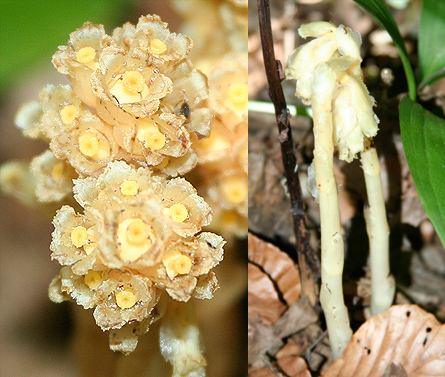
I’m starting the challenge with a really weird flower we identified last week.  It is called Monotropa Hypopitys and has a bunch of common names, one of which is Dutchman’s Pipe.

monotropa-hipopitys.jpg

Mike was convinced it was a fungus because it was growing in a very dark wood.  Also it is fungus coloured, with no green parts.  There is a simple explanation!  This plant does not photosynthesize.  It is a parasite, feeding off the bodies of fungi under the ground.  I was fascinated.

This Monotropa can be found throughout the northern hemisphere, but according to Wikipedia, it is rather rare.

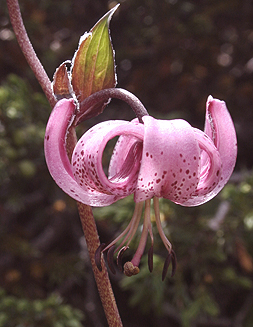
We also saw Martagon Lilies last week.  Antonia was the first to find them, so she is very proud, and remembers their name.  They are quite spectacular, and though not terribly rare, you have to be in the right place at the right time to spot them.

martagon-lily-copy.jpg

Martagon Lilies are only found wild in Eurasia as far as I know.  Perhaps they are garden flowers elsewhere?


Why we homeschool – Part 2 is about why we left school behind

What went wrong with school?  It would be easier to say what went right…. not much!  But let’s start with goal number 1, which was that Antonia should learn French.  Maybe we started too late for her, as she was a very precocious English-speaker.  Being in French-speaking environments bothered her from the age of 18 months, and she said so.  Not many 18 month olds do that, I guess.

At the end of her second year in school, I was very concerned, because she still could not put together even fragmented sentences.  She did not know the names of items she used everyday.  She appeared not to understand simple, common sentences.  She would not answer questions from adults under any circumstances.   She would not play with French-speaking children, and at the age of four her social development was suffering.  Meanwhile her English was pretty much that of an adult and she was friendly and outgoing to all and sundry.  Some brief, intensive sessions with a speech therapist helped to build up her confidence in French, but as soon as the sessions came to an end, she regressed.

Goal 2 was that she should have a nice time.  She didn’t.  Not ever, really.  But things got worse rather than better.  At the age of 2, she would throw screaming fits at the nursery if she was dissatisfied, but she was actually rather pleased with herself when she got home.  At the age of 3, she would say that she supposed she had to go to school because Mummy and Daddy had to work and were too busy to look after her.  She cried every time she forgot that we would prefer her not to.  When she was 4, all hell broke loose.  She cried morning and night over school, and was generally depressed all the time.  I spent my evenings cuddling her, and my days trying to think of ways to make things nice for her. My weekends and holidays revolved around getting her in a fit state to go back again.  I think our only choices were to remove her from school or take her to a child psychologist.  The latter option seems to be extremely common around here, but we chose the former.

Now, it makes sense to wonder what happened at school that was soooo terrible.  What did she do there?  It would appear that she sat in corners making scribbles, which was strange, because at home she was making quite complicated figurative drawings.  She broke glasses or plates at every mealtime, though at home she rarely broke anything.  She declined to learn anything in school, including French words for concepts she already knew like colours and numbers.   But she was very demanding of intellectual stimulation at home.  She learned to read English at home but apparently “did not know her letters” at school.  By then, I was starting to realise that she was good at abstractions, but had to be virtually bribed to handle physical objects.  Montessori didn’t seem like a very good match for her, or maybe her hatred of the school contributed to making her that way.

She also got upset on a daily basis because she got knocked around by other kids, some of whom had behavioural issues, and some of whom had behavioural issues combined with mental handicaps.  She still has a scar on her face to prove that it got pretty rough in there at times.  Her worst memory at this point is of the noise levels.  She spent two years out of the three (the first and last), trying to hang out with the two English-speaking kids in the school who were rather older than her, and getting upset when they wanted to play with someone else. She spent the middle-year in a class with much younger children, many of whom were pre-verbal, because that appeared to the teachers to be the best class for someone who scribbled and didn’t talk yet.  She was very clingy to the adults.  She learned to hide in corners in the playground instead of playing, so that her physical development began to suffer too.  Since she wouldn’t talk, she used clothes as a form of communication.  That’s when she became very, very, interested in her appearance.  She would enter the classroom with her dress held out to show the teacher, as a substitute for saying “Bonjour”.

What did we do during this time?  We spent our time trying to communicate our concerns to the school, wondering most of the time whether we were crazy of they were!  I think they felt the same way about us.  Pretty often, we wondered whether it could even be our child they were talking about.  But then, when I observed her in the school environment, I saw that she had a completely different personality from at home.   I didn’t consider any of the traits I saw her developing there to be in her best interest.  I am so, so glad we got her out.

And why didn’t we do it sooner?  Well, I would have tried something else at the end of the first year.  But the fact is that my husband and I had to come to an agreement and that was not easy.  It only happened because I applied rather more pressure than I am comfortable with.  He had loved the Montessori school he went to and wanted to give his child the same opportunity.  It wasn’t easy for him to realise that it wasn’t suiting her the way it suited him.   Also, I remember very well when I first met him that he and I commiserated over the horrible times we had at school, socially and academically.  But somehow, between then and him becoming a parent, those memories evaporated into a rosy haze of happy children playing together in their own little community! And he was the one who cared deeply about us being an English-speaking household.  That was obviously going to be thrown into question if we homeschooled.  We looked into every possible school, before we were both convinced that it would be more of the same, or worse!

It didn’t help that I was the one on the receiving end of our daughter’s unhappiness and he wasn’t.  In fact their relations were rather distant at this time.  The clash between school schedule and his work schedule meant that he spent very little time with her.  When he did, he took her over to play at friends’ houses and chatted with other adults.  She was glued to me literally at every opportunity, and was pretty direct in expressing her preference.  I know it was upsetting for him.  He was the number one beneficiary of her switch to homeschooling.  Within weeks, she started admitting to liking him, and now she loves us both equally.  But still, somehow, homeschooling ‘feels wrong’ to him.  We get to keep on doing it for as long as he is outvoted, 2 to 1!
Camping trip: the volcanoes of the Auvergne

Yes, France has its own volcanoes, albeit extinct, and we just got back from a two-night camping trip to the Auvergne to visit some of them.  On the first day we met our friends at the volcano theme park for the area, Vulcania.  Now the kids liked this!  They didn’t even mind queuing for the simulated volcano exploration rides.  But I couldn’t help thinking how much nicer it would be if nine tenths of the people were at school when we went.  And both Mike and I have seen so many real volcanoes that the reconstructions of geysers and bubbling mud pools didn’t quite cut it for us.  Still, I can see the point, for the majority people, and it was quite nicely done.

We really had fun on the next day, hiking up the Puy de Dome, then down and across to a crater called Puy de Parigou, then down to the car park.  Then we just drove back to get the other car.  The kids walked 12.5 kilometres and weren’t even tired!

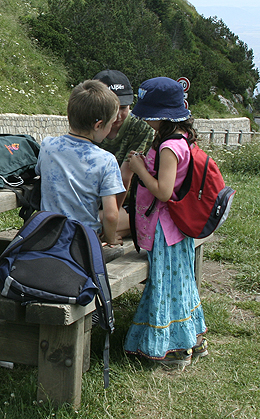
Here are our happy hikers.  I did not choose my daughter’s hiking outfit!  In fact, when I saw it, I packed some trousers in my backpack just in case they were called for:

auvergne-1.jpg

auvergne-2.jpg

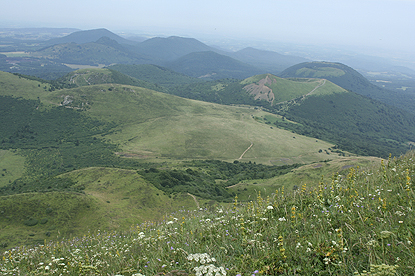
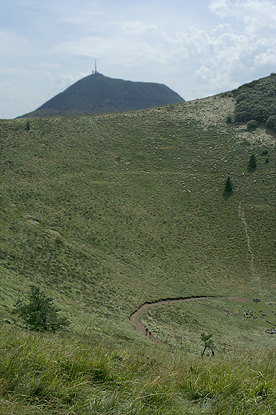
 Where we are going (above).  We are heading for the crater of the Puy de Parigou where the path leads, then down the other side to the car park.  And where we came from (below).  It’s very beautiful countryside and very easy to walk, except the Puy de Dome (the one we came from), which is quite steep:

auvergne-3.jpg

 At 4 o’clock in the morning after this long hike we were awakened by high winds, lightning that appeared uncomfortably close to our tents and showers of rain.  We didn’t mind too much, we were heading home anyway.  We breakfasted under a rainproof parasol at the campsite cafe, and took our tents down during a brief dry moment.  Then we drove for three hours in a torrential downpour, hung our tent up to dry from the beams in the living room, and now we are quite ready to collapse into bed.