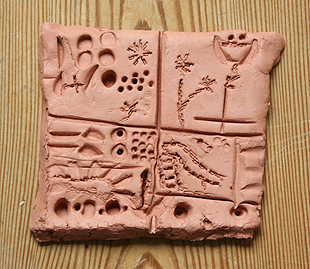
Archive for July, 2008

Why we homeschool – Part 1 is about why we sent our child to school in the first place.

Tuesday, July 29th, 2008

With the social services knocking on the door in a week or so, it’s time to put some ideas in order.  Don’t worry, readers, this is not as terrible as it might sound in the US.  They are not picking on us, but following a procedure required by law.  The law might be picking on us, but that’s another matter.  So, their remit is to find out why we are homeschooling, and that we are actually doing so, i.e. we are not forcing our child to work in the fields all day, and cook and clean as well when she gets back!

They won’t have thought of wondering why we put our child in school in the first place, but it’s a point homeschoolers sometimes raise.  Since we had a reason, I thought I’d start there.  We had heard of homeschooling before our child was born, and I, at least, liked the idea.  But we felt that some aspects of our situation prevented us going ahead with it.  We, the parents, live in France and are English and American respectively.  At least I am English in theory.  In practice, I also lived in France during my childhood so I was bilingual early on.  My husband, not so much.  He speaks French pretty well now.  When we were awaiting our child we obviously had a decision to make over what language we would speak to the child.  My husband was very keen that we both speak English.  He was afraid, and statistics back him up, that if I spoke French and the environment was French, our child’s English would be weak.

The inevitable consequence of English in the home was that our child needed to spend plenty of time with French speakers from an early age, in order to pick up that language as well.  Now, since virtually all French children are in daycare or preschool from the earliest age, and since virtually all their parents are unavailable for socialising in the day time hours, we felt we pretty much had no option.  Antonia went to part-time daycare between the ages of 1 and 2, then to a Montessori pre-school (so not quite to public school) full-time upto the age of 5.  Part-time was not an option.  Our only goals for these years were that she should learn French and have a nice time.  Alas, she did neither.

Nature walk: Lac Achard in the Alps

Friday, July 25th, 2008

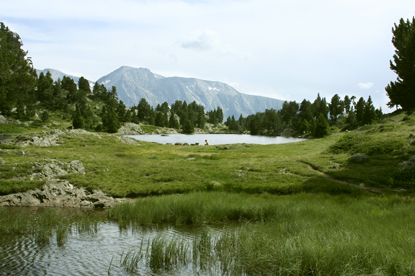
Today, we hiked up to Lac Achard in the high mountains (nearly 2000m).  We were not quite above tree level, but definitely in open land.

lac-achard.jpg

 A change of scene is always nice.  We saw many things that are new to us:

  • A kestrel hovering then diving on its prey and catching it.
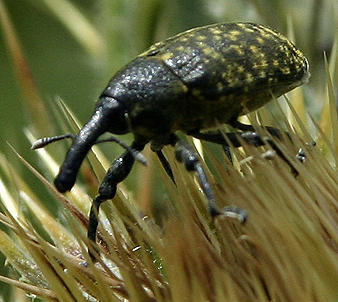
  • A snout weevil with a trunk like an elephant
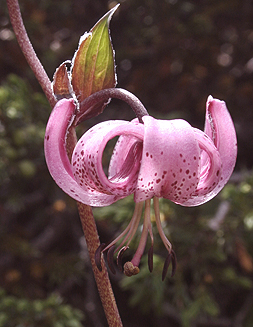
  • Numerous wild flowers of the high mountains, including the yellow gentian that grows as tall as Antonia, and the rare-ish martagon lily
  • Tadpoles, some of which were just growing their back legs, and all of which required little rush houses, built by Antonia!
  • A rare-ish orchid.  With an ant on top of it.  Another ant tried to climb up and they had a long battle, at the end of which the invader fell off. The winner then tried to climb down the orchid, but couldn’t seem to manage as all the parts pointed upwards.

martagon-lily-copy.jpg

snout-weevil.jpg

Homeschooling overview, or where we’ve got to

Thursday, July 24th, 2008

We don’t really have a start or end to our homeschooling year, but sometimes you just have to see where you’ve got to, and I’m in that mood now.  Maybe it’s because I have to send off our homeschooling declaration for 2008-9 in just a couple of weeks.  Maybe it’s because the social services are coming round a few days before that, and their visit will wrap up the requirements for our first year of formal homeschooling. So here goes:

Maths: the 2nd grade maths book we are using is virtually finished, and we are on a roll which I hope will continue into the 3rd grade book.  We spend half an hour on the maths book, 4 times a week.  The work is very varied, so sometimes we finish one problem in a session, sometimes we do a page and a half.  Sometimes, Antonia works by herself and I get the housework done, sometimes she needs my help.  More often, what she really needs is moral support, so I am trying to encourage her gently to be more autonomous.  We also do ten minutes of maths drill every day.  At the moment it’s always multiplication tables, earlier in the year, it was telling the time.

Reading: We read all the time, all sorts of things, by ourselves, together aloud, whatever.  Antonia is more drawn to stories and poetry than non-fiction.  Tracking a child’s reading for record-keeping after they get fluent can be complicated.  I’m recording our after lunch reading books, one is read by her, and one is read by me, and I’m leaving out all the rest.

English:  the reading, writing and spoken language have all come together, so that Antonia reads and speaks well, and above all spells and punctuates the sentences that she chooses to write pretty well.  We worked officially on spelling for a while, but now I see that the visual memory from reading is starting to kick in and she can spell many words I would not expect her to get right.  She is writing about four sentences in English every day, usually a story, which is now turning into a saga, and sometimes a letter.  She’s reading for fun, and beginning to read parts of her history book herself.

French: we are not quite at the same level as in English yet, alas.  She reads at nearly the same level as in English, but even orally, she has a poor grasp or grammar and doubtful comprehension.  She tends to read the way she speaks, where grammar is concerned.  If she were left to her own devices, that would only reinforce the mistakes, so I am going to encourage her to read French aloud. Writing in French will be our big project for next year and at the moment things look fairly grim.  She cannot even formulate a correct sentence to write, let alone set about spelling it correctly. I am hoping it will all come together over the next year.  I will be so glad when it happens, because it is taking a lot of our time.  We are doing written exercises four times a week, spelling four times a week, and reading a passage for comprehension twice a week. I can think of a lot of things I would rather do, and I’m sure she would agree.  On a positive note, I should say that she has very nice cursive handwriting.

History: This is our big success at the moment.  I waited patiently for ages for history consciousness to kick in and here we are.  We are working through Story of the World twice a week, and keeping a Book of Centuries that works for us.  We look through the Book of Centuries once a week to make sure we remember the main people and events.  We do associated activities as and when we please, so we have all kinds of helmets, spears and cuneiform tablets all over the house.  The child also found a broken mug in a yard, collected all the pieces and proudly tells everyone who comes to the house that she is an archaeologist!

Geography: Well, we are still travelling quite a lot!  Aside from that, geography at the moment consists of learning the names of continents, oceans, countries, rivers and regions.  Especially those we have travelled to or studied in history.  Officially, we do this for 15 minutes a week, but in practice, she wants to do it more often.

In theory, we do one of the activities below once a week!

Science: Strangely, for a very science orientated family, we are going nowhere in particular with science at the moment. Pretty often, we do the shopping instead. I feel that Antonia is ready for something more than we had done up till now, but I haven’t found a resource I like.  I am feeling like I have to make my own, and of course that is a lot of work.  In truth, we have done a lot of science already, and if we didn’t do any officially in the coming year it wouldn’t matter, but we absolutely must have something for the year after.

Music: I like the Suzuki Piano program.  I do not think I could say we are making fast progress with it, partly because up till now, Antonia has been practising its pieces for no more than a few minutes a day.  And partly, probably, because I don’t know the best way to teach.  We have averaged one piece per month we were at home, which puts us at piece five.  Piano has probably been our most unschooled subject.  Now, however, we are having one long music lesson per week, and will add music reading soon since Antonia has been saying she feels handicapped by not being able to read.

We also listen to a lot of music.  I feel like Antonia would like to know more about musical forms, and with the arrival of history consciousness she is interested in composers and their biographies.  At the moment we haven’t made time to do more than listen and stick their pictures in the Book of Centuries.

Art: This is like music, it’s one of the things that tends to get squeezed out, which hasn’t stopped Antonia filling her sketchbook with very individual drawings.  I plan to try detailed study of individual pictures.  At the current rate, I think it will take us about one month to study each picture.

Foreign language:  We chose Chinese.  Antonia is very enthusiastic about it.  At the moment, it is mostly consisting of playing the CD in the car as we drive around.  At some point we will have to sit down with the book, because there are other activities connected to reading and writing Chinese.  I am not worried about speed of progress for now.

Nature study:  This consists of a long outing once a week, which might be combined with a cultural or fun activity, and shorter walks several times as week.  We are in a slightly similar position with nature study as we are with science.  We go out a lot, we enjoy ourselves and see nice things, but it doesn’t feel to me as if we are in a different place from where we were last year.  I very much like Anna Botsford Comstock’s Handbook of Nature Study, but there again, as we live in Europe, many of the species are different so I can’t just use it ‘off-the-shelf’.  Antonia is certainly more into outdoor physical activities at the moment which is valuable in itself, but is more of a sport.

Sports:  The sports are all on summer holiday, it would seem!
Easy Book of Centuries

Tuesday, July 22nd, 2008

 boc.jpg

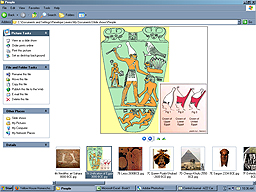
Screen print of our Book of Centuries

We tried to do a Book of Centuries a couple of times before, but it was so hard rounding up the glue and scissors and pictures each time that we gave up. Now, we’ve ended up with one after all.  It just grew while we were trying to do something else.  I thought I’d share the idea in case it suits anyone else.

It all started off because Antonia has a hard time remembering names, and needs to hear them many times before they stick.  I began collecting pictures of the people we had studied in history from all over the Internet. I put these in a single folder on my computer, and set the folder to display as a slideshow.  Once a week we looked through the folder and talked a bit about each person until she remembered their name.

boc1.jpg

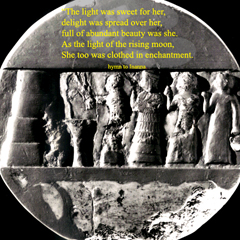
 Enheduanna page, with a passage from one of her hymns.

I soon realised that this was a good place to keep all the artists, composers and authors that she came across too.  Then, we started to use it as a basis for narrations.  Now, the slideshow has grown to include quotes, snippets of scores, famous paintings of events and many other things. I’ve included dates and names in the filename so they don’t complicate the pages.  Also Antonia doesn’t notice them, and the idea is still for her to develop her own memory.

**************************

Here are some more detailed instructions for how I made the Book of Centuries Slideshow.  The most important and least obvious one is last!

Making the ‘pages’:  I wanted to have all the ‘pages’ in the book the same size so I made a blank template in Photoshop.  I’m sure just about any image editing software will work just as well.  I add images from the Internet, resize them if I need to, and add text.  Then I save the whole thing as a jpg.

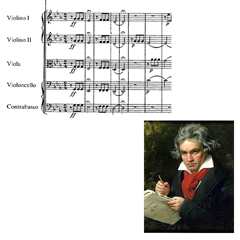
boc4.jpg

Beethoven page with a tiny extract of the score of the 5th Symphony

Displaying in Windows: in the Start menu, click on My Documents or My Pictures or wherever you decide to keep the pictures.  Browse to the right folder.  In the menus choose View, then as Filmstrip.  On my newer desktop, with Vista, things are a bit different.  There is a button that says Slideshow, and that does a very nice job.

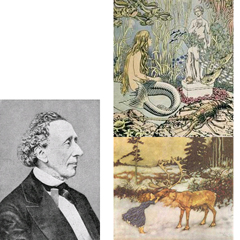
boc5.jpg

Hans Christian Andersen page with illustrations of his tales

Keeping chronological order: I soon realised that Windows liked to sort my pages in a way that had nothing to do with chronology.  I fiddled with the file names and eventually hit on the following scheme.  Perhaps other people can think of a better one!  My file name starts with a letter or number that indicates the century, or a longer period for earlier times.  Z is for the 21st Century, A is the 5th Century BCE.  The number 8 is the whole 2nd millenium BCE.  When I want to sub-sort, I add another letter AA, AB, AC and so on.  I’ve accepted that I’m going to have to modify the names of the files within each group from time to time to keep them in order. Who knows, if our book grows really big, I may break it into a separate folder for each century.

Real travel: Geneva

Sunday, July 20th, 2008

Yesterday we drove up to Geneva and back, mainly to see some relatives who were passing through. Since we were travelling to Switzerland, which is not part of the European Union, we theoretically needed our passports. In practice the border crossings in the little villages where we went through were completely unmanned. The main border crossing is manned and very busy, but if you go through there you get on the motorway. The Swiss pay a largish annual fee to use their motorways and charge the same to visiting foreigners. We were reluctant to pay this just to travel 12 kilometres into Geneva centre for the only time this year. So we had to take a roundabout route on the backroads.

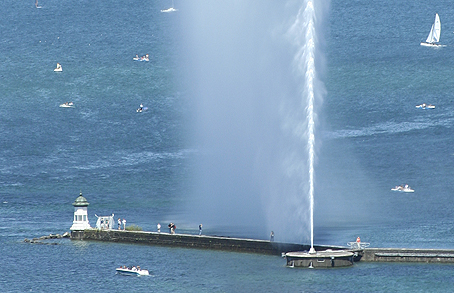
We spent most of our day chatting over lunch, but we also visited the church in the old town, and climbed the towers. We had a lovely panorama of the lake with its giant fountain.

geneva-fountain.jpg

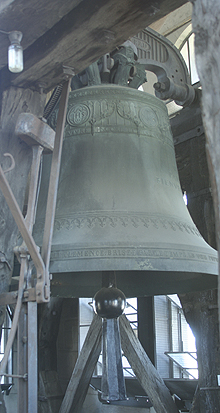
We also got to see a model of the church and the bells. This one is called Clemence.

bell-in-geneva-church.jpg

Geneva was important in the Reformation, or perhaps conversely, the Reformation was important to Geneva. The main organiser in the city was Calvin, who was French. Strangely, we mostly remember the Reformation in Geneva because Jean-Jacques Rousseau fled from its rigid theocracy (I am quoting the cliché here). Nowadays, we think of Calvin as Swiss and Rousseau as French, though I doubt either would have seen it that way. Our relative was interested in the Reformation, which I had also studied. I was having a hard time remembering any details, but fortunately there were some explanatory posters around.

Blue Lion Cub

Friday, July 18th, 2008

I’m the proud owner of an actual car, and it’s a doll!  The tiny Peugeot 107 but it’s just right for me, Antonia, and the picnic basket.  Also it’s a pretty blue colour and has a CD player, so we are both very happy.  It came a couple of months earlier than expected, causing an unexpected cash flow situation.  On the other hand I came back from the UK to find we were still a one car family so its arrival really eases that strain.  No more choosing between being a prisoner at home or tagging along on major driving around sessions where everyone tries to get all their conflicting activities done!  This car is tiny, relatively green and cheap to run, and drives very nicely so far. Many people have this suspicion that since we live on a mountain we need a big, powerful car. This is not quite true.  These little city cars are strong on the lower gears with less power in 4th and 5th.  To drive on hills you mostly need the lower gears (to American readers:  the car is a stick shift, like 99 percent of cars driven in Europe). Also the car is very light.  What with one thing and another, it climbs at the same speed and in the same gear as our SUV.  Mike thinks it will fare badly in the snow, but I think it will only be grounded on the four or five days a year when it is actually snowing.

Now I am thinking that with all the excitement of having a new car, and because it is a very simple car, now is a fine time to teach Antonia some basic car mechanics and maintenance.

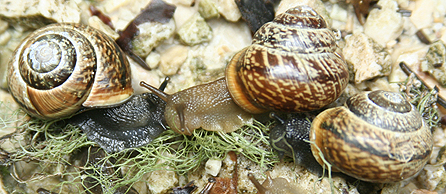
Nature Study: snail body colour

Thursday, July 17th, 2008

snails.jpg

We were walking through the woods when we found this little group of snails having a party in the middle of the path.  It looked like they were eating lichen. And the strange things is that two of them are beige and two are dark grey, even though they seem to be the same kind.  Why is that, I wonder.  Here is one thing I discovered by doing a search on the Internet:

There is geographical variation in body colour in the land snails Cepaea nemoralis and C. hortensis along a transect of 88 samples from the north of Scotland to the Pyrenees. Paler body colour is associated with higher mean daily maximum temperature in both species. Laboratory experiments show that dark-bodied snails heat up more rapidly and reach a higher equilibrium temperature than do pale snails when exposed to radiant energy. Climatic selection favouring pale body colour in warm areas and dark body colour in cold areas is probably responsible for the association with climate.

********************************************

Antonia was busy with a play date all day.  I spent the morning reading a book by myself (!), and the afternoon on my translation project, which is nearing completion.

Nature walk: flint nodules

Wednesday, July 16th, 2008

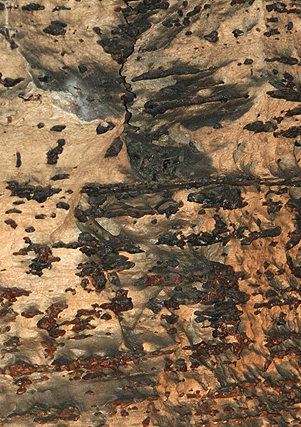
flint-nodules.jpg

We had a hot summer’s day and the pleasure of heading for a nice cool cave.  I like this one because it has a very low key presentation for visitors (apart from the sound and light show of a local legend), and also because of the lovely flint nodules studding all the walls.  The really amazing thing about flint is that like limestone, it’s a rock composed from a living origin.  The nodules form in burrows or other holes left by living things in the limestone as it was forming.  The silica in the flint comes perhaps mostly from micro-organisms.  Too cool.

I love real caving, as long as I’m with a guide who knows what they’re doing, but I have to wait a couple of years before I can take my daughter.  Mike does not love caving. When he was young, he went caving with a couple of buddies who thought guides were for wimps and unexpectedly spent a night lost in the darkness!  Then when they got out, they got told off by the rescue services for being dumb.  I guess it put him off for life.

Bastille Day

Tuesday, July 15th, 2008

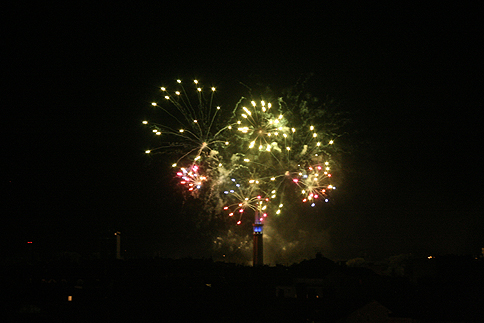
fireworks-1.jpg

We found an idyllic spot from which to watch the Bastille Day fireworks which started as soon as it got dark.  This year’s display was pretty and artistic in a low key way.

 fireworks-2.jpg

In the morning, we studied the French Revolution from the fourth Story of the World book, another example of how we skip around.

A little message for Sargon!

Sunday, July 13th, 2008

cuneiform.jpg

Antonia wanted to make a clay cuneiform tablet.  It took her a little while to get the hang of printing rather than drawing and to strike the balance between representation and signs.  The tablet above would seem an apt message for Sargon, whom we have been studying, and almost any number of other leaders, past and present.  It reads, from top left to bottom right:  Have Fun (fireworks); No Fighting (a man and an explosion); Really Do Not Fight (spears lying down); Go Play (a slide).

Antonia is now enjoying the Story of the World books by Susan Wise Bauer, and I am glad that she is getting into history at last.  We have not necessarily been working through the book in order.  During our trip to India we did the Indian sections from all four books.  We have done some parts of Roman history when we went to Rome, some Chinese history when she began studying Chinese.  But right now, globally, we are working on the first book.  I usually have a web browser to hand as we are reading so I can dig up more illustrations and we discuss as we go along.  Then we do miscellaneous projects, if we feel like it, like the tablet above or further research.  Today we learned about Ziggurats and the legend of the Tower of Babel.  Antonia reads the stories in the books and I read the documentary text.  We spent quite a while mastering the geography of the places we are studying and the dating system.  We are both enjoying ourselves.