Monthly Archives: March 2008

Gendered perspective

I commented on a thread the other day in response to somebody who was staking a claim for the ‘girls like dolls/boys like trucks’ point of view. (Waste of time, I’m sure, but I did it anyway).  I noted the subtle way these tendencies had been produced or reinforced by the staff at the daycare Antonia attended.  Little boys who picked up dolls were ignored, whereas the adults interacted a lot with girls who did the same thing, asking them all kinds of questions about the doll.  All of it completely unconscious.

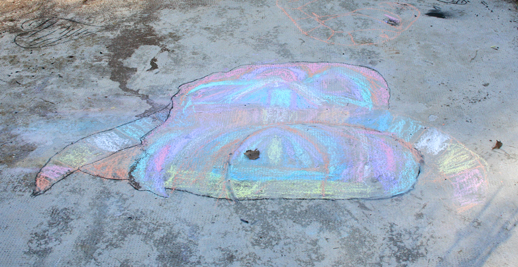
One way or the other, our children grow up with gendered perspectives, but it isn’t always as straightforward as it seems.  Yesterday, Antonia described and drew for me the transport she wants to own as an adult.  It’s a massive, powerful, monster of a purple motorbike, with a propellor and a retractable raincover.  Batman would be proud of it.  It also has four seats, for her babies and her dear old Mum (me), and a sidecar with nappy changing facilities!

An unusually schoolish reading/spelling resource

I can’t imagine this would be to everyone’s taste but it works for us.  Periodically, I’ve used the word lists that can be found at the bottom of this page with Antonia.  (BTW, these are part of a reading program that I never joined).  I started doing this because she’s naturally a globalising reader.  This does have limitations as well as advantages and I’ve wanted to give her phonetic skills a nudge from time to time.  I planned to do it very briefly, and soften the blow by making it into a game.  I didn’t bargain on Antonia loving to read word lists.  During the reading, she would have great fun discussing the definition of words, finding rhymes or conjugations of the same word, and putting the words in sentences.  The strangest thing though, is that doing word lists would always spur her into renewed independent reading, whereas if I had her read with me she would consider herself done for the day.

Well, she’s a bit beyond that stage, now.  Her ‘reading grade level’ of 5.6, on the test on this same page, outstrips her actual comprehension of the vocabulary.   I don’t do anything about her reading any more, I just let her read at her natural comprehension level.  But it’s recently dawned on me that her spelling level in either language is barely grade-level appropriate to be generous.  That could be a consequence of the globalising tendency also.   So I pulled out the grade 1 word list again and started working through it.  And guess what!  First, she loves doing it, and second, it’s revived her interest in writing by herself.  Yesterday, she got out a set of writing cards she was given some time ago and had polished off a couple of postcards in less than an hour.

Homeschool Record : 10 – 16 March 2008

pavement-drawing.jpg

Lessons

  • Maths book: subtractions, plans, calculator, solids. Freres lyons maths exercises
  • Spelling: review of numbers in French, the sound o, au, eau; use of s or x for plurals
  • Writing: capital letters, dictation 1 from CP dictation book
  • Narration: Le Feuilleton d’Hermes

The Unschooled Stuff

Reading

  • Lots of independent reading during car trips, evenings at home
  • Co-read: Le Fromage Magique, various parts of Martine a la Maison, the end of The Magic Treehouse 3, Mummies in the Morning
  • Read-aloud: Tistou les Pouces Verts

Maths/Logic

  • A little phase of doing mazes several afternoons in a row
  • Play revision of telling the time, multiplication tables by 1 and 2
  • Discussion of advantages of weighing chocolate versus counting squares

Science/Nature Study

  • Examined a dead leaf under the microscope. Learning to use the slide table controls and focusing knob. Learning about the depth of a small sample under the microscope.
  • Went out for walk in the rain: catching water in cup, muddy puddles, mud, shiny pebbles and happy mosses and lichens, then home for hot chocolate, …
  • Inspected our growing sunflowers: measured height, observed second leaves sprouting, identified possible young apple tree among the weeds (from the seed case), removed others.
  • Watched 2 episodes of David Attenborough on Life in the Undergrowth
  • Lots of discussion of bees and their ways

Arts and Craft

  • Lots of free drawing
  • Looked at pictures of various greek gods we’ve been reading about, etc
  • Four seasons watercolour series
  • Snowflakes and other origami and paper cutouts, masks
  • Playdough and other modelling things
  • Made a Kolam design for the terrace

Practical Life

  • Finished making chocolate truffles
  • Made chocolate mousse
  • Picked and made crystallised violets

Music

  • Piano practice
  • Went to a harp concert
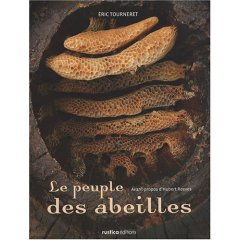
  • Cuddled up to watch Swan Lake on DVD, while I read le Peuple des Abeilles
  • Listened to bagpipes and looked at traditional Scottish costume with kilts

Sports/Games

  • Played Blind Man’s Buff, then turned it into a sensorial alphabet puzzle game

Out and about

  • Dance class
  • Swimming lesson
  • Day of downhill skiing
  • Day of play with friends

Candy-making for beginners

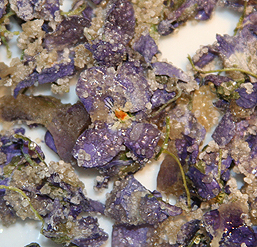
 Antonia and I are planning to learn to make sweets of all kinds.  And we will be calling it chemistry.  We started with crystallised violets, which can only be done at this time of year of course.

crystallised-violets.jpg

Crystallised violets are very retro.  I suppose we must be in that kind of mood.  By the time I was a kid they had already morphed into artificial purple blobs.  Now they’ve disappeared completely, presumably because the purple food colouring turned out to be carcinogenic.  I can see why the real ones aren’t mass marketed.  If we want to improve them next time, we will paint each one with egg white individually using a small paintbrush, as the recipe suggests, instead of just dunking them.  And I would go with the ultra-refined, pure white, finely crystallised sugar instead of the earthy, organic stuff we usually use.

We also made fudge, but as we didn’t have a sugar thermometer at the time we undercooked it.  The mixture sat around the kitchen for, errrm…, several weeks while it dried to a suitable consistency.  Now it tastes just right.

fudge.jpg

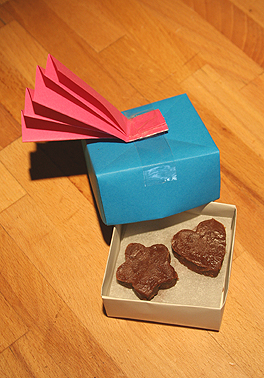
We are fairly expert at origami by now, so making the box to keep the sweets in was a singe.  I love making boxes, plates, envelopes and folders, which must be one of the most useful and easy branches of origami.

Not so insipid harp playing

Yesterday evening, we went to a harp concert that I’d picked out more or less at random.  I hadn’t taken Antonia to a concert for a while, and assumed she would like harp playing.  Of course she did, and her first reaction to seeing the seven year olds from the local school in performance was “I want to as well..”.

After the school performance, which was all very nice, we got a performance from a professional harpist, Isabelle Olivier.  It was, to say the least, experimental.  She worked with a sound ‘wizard’, Olivier Sens, and they produced an improvised exploration in sound.  It wasn’t until they started, and my ears perked up all by themselves, that I realised to what extent I’d just been listening politely to the previous half.  I hadn’t enjoyed myself so much at a concert since I lived in London.  I was just about to revise my view of Grenoble as a provincial backwater of culture, when the old fogies in the audience started to stir.  They peered desperately at their programs as if seeking an explanation. Then they began to leave – about 30 of them all told!  I don’t think I’ve ever been to a concert where that happened.  So Grenoble remains pretty provincial in my book.

I don’t know what I think of their manners.  OK, so they didn’t like it, fair enough.  I did, and their messing around getting their coats and so on was pretty disruptive to my listening.  I don’t think I’d walk out on a concert myself if I hated it. I’d just chalk it up to experience.

Rambling about reading

martine-a-la-maison.jpgThe right to read trash

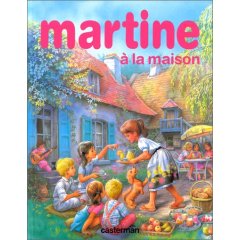
The readers bill of rights is pretty clear: readers have the right to read anything. I shouldn’t be surprised, should I, if my daughter’s favourite reading consists of pink trash like Winx and Martine. Of the latter, I will only say that when I asked on her behalf at the local library, I was met with a dirty look, and informed that they didn’t stock anything as old-fashioned as that. Quite right too – the collection I bought today from the local supermarket consists of edifying works such as ‘Martine does the spring cleaning’, ‘Martine the little cook’, ‘Martine takes care of baby’, … you get the picture. Never mind. I read Martine when I was little, and I still grew up to be a tomboy, then a feminist. Maybe it helps to rub our noses in this stuff when we’re young, so that we recognise stealthier approaches to sexism as we grow older?

Co-reading

This is how Antonia likes to read best: we snuggle up together and take it in turns to read aloud, one page each. So it looks like I’ll be enjoying ‘Martine, the traditional little girl’ all over again.  Mine is a very social kid, and wouldn’t read nearly as much if she didn’t have an opportunity to make it a social activity.

Invasion of privacy

After being able to read quite well for some time, Antonia’s finally crossed over to the point where she can read my emails, regular post, blog posts, other people’s blogs,  newspaper articles, or whatever I’m translating over my shoulder.  For some reason I wasn’t ready for this.  Naturally, I haven’t been able to call my body or my time my own for the last six years or more, and on the whole I coped with that quite well.  Now I’ve lost this tiny bit of private adult space as well, and I’m starting to realise just how much it meant to me.  I’m also freaking out just slightly about the content of some of the things she is reading. There will be readjustments, and it’s really a positive development of course.  The whole point of reading is to be exposed to stuff.

Wild about honey bees

bees-book.jpgI bought this book just as a treat, because the pictures in it are too beautiful. Now the passion for honeybees is growing on me and Antonia. In another life, a life in which my husband was not allergic to honey and I traveled less, I think I would be a beekeeper. I’m fascinated by their senses, their communication, their life cycles and their castes. I’m blown away that they have five eyes of two different types, and two kinds of ‘ears’. And that the workers cycle through a series of tasks during their life, from comb maintenance to brood nursing, guarding to gathering, and that they develop the appropriate organs accordingly. And the stuff that they collect and produce is so attractive to the senses: pollen, nectar, honey, wax, propolis. They’re so furry, I could cuddle them if they didn’t sting, and they have such a hypnotic hum.

In my dreams, I would have a natural observation hive, in which I could just watch the bees do their own thing, and maybe pinch one of their smaller combs from time to time. In fact, the hive I want is this one, below. Maybe I could get those people to swap houses with me! The wild combs are so beautiful, I just can’t help wanting to reach up and steal one, and munch straight into it. They look like galettes, and they must be appealing to some very primitive instinct in me. I don’t think the manmade combs are pretty at all.
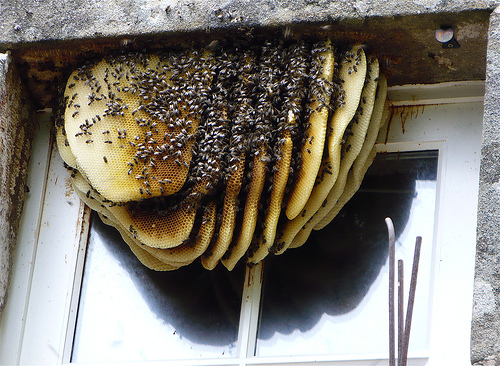
beehive.jpg

Taken by Max xx, a fellow Brit in France, apparently, from Flickr with a CC licence.

Poor bees. They have been having such a hard time lately. It would practically be a civic duty to let some live behind my shutters. Can you just hear me talking myself into something here? In my obsession, I’ve been reading everything I can find about bees. Some proponents of natural bee-keeping like this one, think the bees will do better in more natural conditions. Standard bee-keeping encourages them to build bigger cells and bigger bodies, produce more honey and less wax than they might choose, get moved around so that they produce honey from single plants, refrain from their usual reproductive activities if possible, and live off sugar syrup once the results of their labour has been harvested. When you look at it like that, it’s no wonder they’re struggling. And those nasty artificial combs don’t look nearly so hygienic, safe or well-ventilated as the natural ones, to me.

I was musing on this today, and it suddenly struck me as a pretty good metaphor of homeschooling versus schooling. Like the standard hives, schools provide a ‘safe’, prepared environment that’s designed to draw out some human characteristics further than they might otherwise go while repressing others, and train kids in the habit of over-productivity. Turns out the environment isn’t as safe as all that, and the kids end up weakened in various ways. Then lots of us go on to live adult lives that are much the same. Too much working to produce honey/knowledge/money and the honey ends up too thin, too purified and easily diverted to other people’s ends. Not enough wax, the relationships and life skills that hold people’s lives together in the first place. Bzzzzzz…. I imagine this metaphor will only make sense to me.
Freres Lyons maths

Antonia is whizzing through her maths book so fast these days, I thought we would try something different as well. A lot of the other homeschooling families I know in France use Mathematiques des Freres Lyons. It’s a free program from Canada, for children aged 5-7, especially home-educated kids, and I suspect it’s only available in French, because I’ve never heard of it elsewhere on the net. It turns out that anyone who can read French well could use this program with their child, even if the child doesn’t speak French.

I sent off an email and received the first six chapters of the program in pdf format. Each chapter contains a series of exercises based on manipulatives that you can easily make, or that you probably have around the house, like a pack of cards. There is very little writing or recording, and the emphasis is on the child developing their own thought processes through working with the manipulatives.

The first chapter is just for the parent’s information and is a series of exercises to see if the child is still a pre-operative thinker. The program tends to assume that they will be. The first test is quite well known: it involves half filling a clear bottle with water, sealing it, showing it to the child, then tipping it on its side. Many young children will believe that the bottle no longer contains the same amount of water.

These tests were interesting to me. Antonia is mostly a post-operative thinker. She can quantify large groups of objects in her head and does so automatically, and can explain all the conservation tests. With one big exception: she has not mastered the intersections. When shown a picture of 3 lions and 2 donkeys she will say that there are more lions than animals, even if previous discussion has established that lions and donkeys are both animals. I was surprised enough that I did the test again, in English with other categories and got the same result. I think that explains a lot about her thinking, as she often seems very adult in her reasoning, and then there will be a sudden black hole of comprehension. Strangely enough, she can do Venn diagrams, presumably because she’s been alerted to the need to pay extra attention in that exercise.

Based on the expectations of the program, it might have been more appropriate to start it a year or two ago, but I’m still finding it useful for us. Antonia has this tendency to leap to answers that seem obvious to her and flounder if they are not obvious. She finds it hard to deal with situations with multiple answers or no answer at all. She also finds it hard to prove or explain things that seem obvious to her with a physical demonstration, or to manipulate objects and experiment with them. I think it’s really good for her to learn all those things, even if she already has the numeration skills. It’s also fun, more like games really. We’re both really enjoying it so far.

Science experiment: make your own ‘fossil’

make-your-own-fossil.jpgAntonia chose this science experiment from her magazine. One of the cool things about homeschooling is we actually have time to do the magazine’s activities if she wants to. My childhood memories are filled with the input of good ideas from many sources and not time to carry them out.

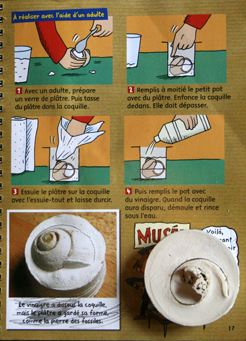
This is one of those experiments to make something that looks a bit like a fossil. Basically, you fill a snail shell with plaster, set it in a plaster base, then dissolve the shell with vinegar. I was somewhat dubious as to whether this would work well. Actually, the incomplete form we ended up with is probably more realistic.

Rainy day walk

rain-walk.jpg

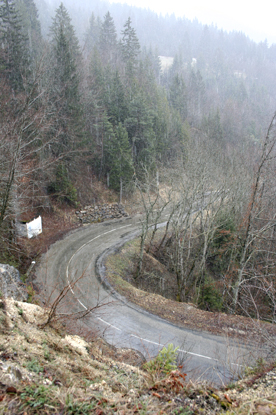
It’s one of those Charlotte Mason things: get outdoors every day, even if it’s raining. The rain won’t actually hurt you! So I thought we’d try it and see what it’s like (well OK, I used to do a paper round and walk a dog, come hell or high water). So – here we are at the freezing point, in sleet actually. Antonia has been dancing around trying to see how much water she can catch in a plastic cup and refusing to use an umbrella. For some reason she then decided to tip freezing water all over her jeans. She wasn’t soooo happy, until she got distracted by muddy puddles, mud, shiny pebbles with mud on and footprints in the mud. I was the only one who seemed to notice or care that all the mosses and lichens were twice as big and green as usual. Mike crouched under his umbrella, shivering. It was all pretty good fun, though three-quarters of an hour is probably enough.

I’m sure the other two will agree that it made it extra nice to come home, stoke up the fire, make hot chocolates, and snuggle up under the covers with Swan Lake on dvd for Antonia and a book for me.