Archive for March, 2008

Graves of Academe

Sunday, March 30th, 2008

I have found more school conspiracy stuff to read on the Internet.  This time it’s Richard Mitchell, with, for example, ‘The Graves of Academe’.  I must admit that I’m enjoying it an awful lot more than John Taylor Gatto, though I liked that too.  I suppose Mitchell felt that he had to maintain a certain level of written English, if he was going to pick on the dummies.  Not lak wot ar does ‘rand ‘ere. Besides that, he and Gatto probably have a point, and it’s pretty precisely the same one.  I hate to condemn a group of people on the basis of selected quotations, but it certainly looks to me as if the members of that Commission on the Reorganization of Secondary Education all wanted shooting.

Although I’m sure functionaries in all cultures are expert at the passive voice and the concealment of agency, it seems to have sunk into American mainstream culture much more than it has elsewhere.  I encounter this all the time in my own life.  Normally, a British wife can ask questions such as the following of her husband, in a spirit of innocent and idle curiosity:

“Did you, or did you not, on the evening of March the 30th, 2008, substitute 2lbs of assorted red hot chilli peppers and spicy sauces for the 2lbs of beef in the beef chilli recipe, and, if you did, then why did you do so?”

The true-blooded American tends to take the implication of personal agency as some kind of incipient accusation and reacts defensively. I have learned from bitter experience that polite responses in American English must involve me-statements, I think they’re called, and preferably ones that invoke the speaker’s own deficiencies. Something like “my taste-buds just haven’t been sufficiently trained for this” will do, or even the oh-so-common “I’m sorry, I don’t think I can eat this”. In British English, the first of these is assumed to be sarcasm in its snidiest form, the second is just not done. You damn well do eat it, even if you have to resort to such childish subterfuges as distributing it around your plate so that it looks as if most of it has gone, or mixing it with large amounts of something palatable. Alcoholic beverages are recommended for this purpose. That’s why the Brits drink so much.

Now as for the French:  I’ve occasionally glanced at the texts they print for schoolteachers here, and I once bought a book entitled “What your child learns in Maternelle (preschool/kindergarten)“.  One day I’ll dig it out and translate some passages, just for a laugh.  Suffice it to say that although I’m very fluent in French, and although the book is more than 200 pages long, I have no clue what the authors think kids are learning in Maternelle.  As far as I could tell, it was a long string of words, signifying nothing.
Making music

Saturday, March 29th, 2008

Mike’s latest little scheme or project is to build himself a fully-functional synthesizer on a shoe-string budget.  Today he found some freeware to tinker with and couldn’t wait to show off his new ‘noises’ as soon as we walked in the door.  Antonia sat on his lap and listened intently and thoughtfully.  Then she took his arm in hers and said, her voice oozing with diplomacy and kindness, “Daddy, … can I show you how to make some real music now?”.

She’s is growing up so fast at the moment.  Our deficiencies in various skills are starting to become apparent to her, and she just knows she can do better.  We are in Trouble!  Well, not really, of course… this old lady dog still has a few tricks up her sleeve!  As in: You think I cooked lunch/cleaned the floor/stacked the logs/…/ inadequately?  Show me how it should be done!”

I wouldn’t be without her in a million years.

Dumbing down

Friday, March 28th, 2008

Dumbing down is the topic of the moment at our house.  We, the adults, are reading through John Taylor Gatto’s Underground History of American Education on the Internet, with his theory that public schools were created to make people dumb.  Mike is really into conspiracy theories right now, so I had to divert him to a new one, just so we could talk.

I see dumbing down in the media particularly – since we don’t have too much to do with schools right now.  The ‘good’ characters in movies and TV programs, the ones you are supposed to identify with, seem to be getting thicker and thicker by the year.  Now they even talk like retarded 4-year olds, even if their adults.  At least 99% of adult human beings are capable of doing better than that.  And I’m not just complaining about movies aimed at children.  If, by chance, an intelligent character strolls into the plot, he/she is bound to be on the side of evil.

Antonia has been doing a narration of Shakespeare’s Midsummer Night’s Dream for a homeschool magazine we sometimes participate in.  We both agree that Helena is a total dummy and an idiot, and that she and Demetrius just about deserve each other.  Now, compare a monologue by Helena trying to make sense of life, with a monologue by any dummy in a contemporary movie of your choice.  Shrek was the movie that came up in our conversations.  It’s scary.

I will be keeping my eyes open for movies that portray the intelligent and capable in a positive light from now on.

KNL Dragon

Thursday, March 27th, 2008


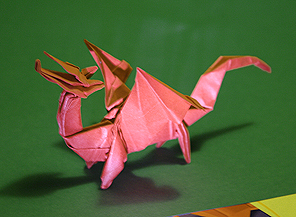
dragon.jpg

Hee, hee, … I get to brag about my miserable accomplishments now! I am working through Robert Lang’s  Origami Design Secrets at the embarassing rate of about a chapter a year.  This is my first origami fold with a graft in it.  A graft is basically where you take a square of paper and fold it in such a way that you have a small square and a medium sized one to work with.  Then you get to do two separate models in the single sheet – in this case the head and the body.  I spent a lot of time thinking this was going to be yet another CPP (Crumpled Piece of Paper), but it looks almost as it should.

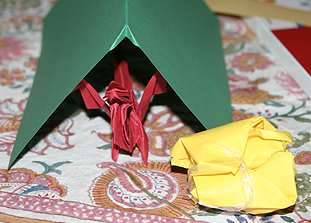
dragon-habitat.jpg

Antonia designed a habitat for it, reinventing the reverse fold in the process, not to mention controlled use of the CPOP.

Thursday, March 27th, 2008

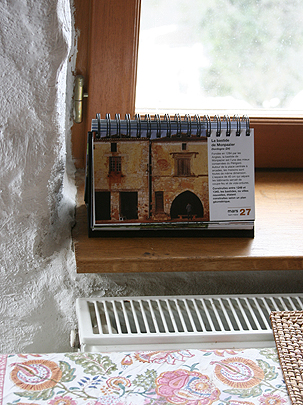
perpetual-calendar.jpg

We have these perpetual calendars by the dinner table, where they basically act as conversation pieces.  This year we have 365 photos of France and a CP (grade 1) word calendar.

Today’s French calendar was particularly cool.  This is the Bastide de Montpazier in south-western France.  It’s a planned town like Milton Keynes or Columbia, but built in the 13th century.  Its already a bit surprising to find urban planning at that date, but I had come across other examples when I studied early Renaissance Tuscany. It was built at a time when this part of France belonged to England, and the idea was to reinforce the English presence near the French border.

Now the really interesting part is that as the town was carefully designed, there is a 40cm gap between the buildings.  It was put there to act as a fire break and for, erm… waste disposal.  We had a great time with this!  Our first thought was that it would be more of a fire hazard, but we were thinking modern waste: paper, plastics, and so on.  Their trash probably consisted of kitchen waste, sewerage, and maybe some broken pottery.  Very wet. A perfect little compost heap.  A bit smelly, I would imagine, but useful.  We wonder if it generated enough heat to help warm the houses.  Without actually becoming a fire hazard?!  Why have none of the eco-architects come up with a way to heat our houses with compost heaps?

Montpazier is now classed one of the most beautiful villages in France.  We have never been there – yet.

Thoughts about pregnancy, labour and birth

Wednesday, March 26th, 2008

Recently, an acquaintance who was due to give birth asked me for advice.  I think my husband had told her that I’d done a lot of research about it or something.  I tend not to be too forward on these occasions.  I’m kind of uncomfortable about influencing people about something so personal, and I’m not even sure if it can work.  But in retrospect, I kind of wished I had said a whole lot more.  She is fine, the baby is fine, but things could have been better frankly.  How often have I felt that?

Then Humble at Free Range came up with this, and nudged my conscience some more. So, here is all I have to say on the subject, for what my views are worth.  When I had my single child, I did indeed do a huge amount of research on pregnancy and birth, and made decisions which are relatively uncommon, but turned out perfectly for me and my child.  However, this is not about promoting my choices to other people, so I’m not going to even say what they were.  This is about more generic issues. I really believe the world would be a better place if all women (and men) knew about, or would at least give serious consideration to these points:

  1. Early miscarriages are very common. Having a miscarriage when you wanted a baby is always going to be upsetting, but realising that it’s a distinct possibility before you begin may help, at least I think so.  It’s difficult to say exactly how common miscarriages are. For the part of the first trimester in which a woman already knows she is pregnant, about 20%?  The probability of a miscarriage in this time frame may be even higher with a first pregnancy.  The majority of women have probably had at least one miscarriage.
  2. We’ve all heard that birth is a dangerous process that claimed the lives of droves of women and infants in the past and continues to do so in third world countries?  It’s worth knowing that the most common cause of death ‘in childbirth’ in these contexts is infection in the days following the birth.  The second most common cause is attempted abortion (yes, this is classed as death in childbirth).  The third most common cause is blood loss from the detachment of the placenta immediately after the birth.  None of these dangers are currently a matter of great concern to western women giving birth to full-term infants.  Risks tied up with labour and birth  as we experience them exist, but are very rare.
  3. Although many women report finding labour and birth to be painful, uncomfortable and exhausting, it is extremely rare for there to be any relationship between these discomforts and a real danger to mother or child.  There is no need to be scared as well as uncomfortable.
  4. Not all women find labour to be painful.  One of the most common causes of pain in labour is the position of the mother, and/or the position of the foetus within the womb.  It is easy to change the former, and there are some possibilities for changing the latter, before or even during labour.
  5. The phase of pushing the baby into the outside world is more likely to be painful than the earlier stages of labour, yet there is almost universal agreement that this is not a phase in which it helpful to have our sensations deadened by painkillers like epidurals.
  6. In case the only births you’ve ever seen before your own are in movies, all that screaming and agonised face-twisting on the part of the mother is just put there for melodrama.  At the point at which these actresses are usually screaming, I was inquiring of my husband whether he had indeed given the midwife a parking permit as previously arranged.  That sort of thing just doesn’t feel right to movie producers.
  7. Everybody seems to go on about the size and estimated weight of their babies compared to their own and the impact it’s going to have on the birth.  It’s obviously ludicrous to be concerned about any measurement except the circumference of the baby’s head.  Even that’s not so relevant when you consider that the baby’s skull plates are designed to reshape themselves for the birth, whilst the ligaments in the mother’s pelvis are designed to allow the bones to separate.  Yes, it is true, they will only do it as a result of significant pressure, but they will do it, and it is safe.
  8. Natural births are pretty rare these days, and the medical professionals working with us are unlikely to know what levels of variation occur normally and safely within a natural birth process (length of gestation, length of labour, …).  It has become difficult even to research such a thing.  Some of the research that has been done seems to be suspect.  Interventions intended to keep our pregnancies and labours ‘normal’ may not be based on valid evidence of what normal is.  I am talking particularly about things like induction and augmentation, but also various types of monitoring.
  9. Most hospitals measure cervical dilation to see how labour is progressing.  There seems to be an assumption that the cervix dilates in a linear fashion.  I have read a lot of anecdotal evidence that suggests this is not the case.  It seems like the cervix can stay exactly where it is for hours, then reach full dilation in minutes.  That’s worth thinking about and researching, especially before we allow ourselves to be encouraged/discouraged by our cervical dilation.
  10. The WHO believes that the rate of cesarean section should never need to be higher than 10 to 15% of births.  In my view, this already allows a lot of safety margin to include borderline cases.  The actual rate is much higher in a lot of countries.  Planned cesareans account for some of this figure. Planned cesareans are not at all in the interest of the mother or the foetus, except in very, very rare cases.  They do seem to be in the interest of the medical profession.  There are almost certainly ‘too many’ emergency cesareans, yet nearly everyone who’s ever had one believes it was necessary in their case.  Other people implicate mismanagement of natural birth processes, see point 8.  Cesareans cannot always be avoided, but they are more dangerous and more uncomfortable post-partum than natural birth.  They arrest the processes surrounding birth in both the mother’s and babies’ bodies, with possible negative consequences.  They leave scars, yet apparently fail to protect womens’ bodies from some of the less desired effects of motherhood.  It seems sensible to take steps to avoid them, sensible too to consider under what circumstances you might need one, and how you might minimise their impact before labour starts.
  11. A woman in our society may give birth to two/three children on average.  Even if she has a dozen, each birth is still an extraordinary and incredibly special moment in her life.  That is as it should be.  Birth and the immediate aftermath may also represent her (and the father’s) first acts of conscious parenting.  Medical professionals involved with birth may attend a dozen a day (or more?).  There is a big risk that birth becomes banal for many of them.   As authority figures with a lot of things to see to, they may not be very sensitive to ‘acts of parenting’.  There is the potential for a major clash of perceptions and interests here.
  12. The post-partum phase merits more attention than women sometimes seem to give it.  Breast-feeding is often not completely problem-free, especially the first time.  I believe it’s worth planning to have help available beforehand, such as from the LaLeche league or an experienced friend.  Physically, you may feel uncomfortable for some time.  In past times, women were expected to spend a day or two in bed after a birth.  I ignored this because I felt just fine, and subsequently wished I hadn’t.  It’s unlikely that our bodies will ever feel or look exactly as they did before a first pregnancy.  Mood swings in early post-partum are normal, but look out for the rarer post-partum depression.
  13. The intensity with which a mother bonds with her child, and the length of time it takes to do so varies.  It may be virtually instantaneous, even in a mother who was previously ambivalent about the expected child.  It may take months, even with a planned and desired birth.  I don’t think anyone really understands this process completely.
  14. In many cultures birth has been treated as a victory for the mother.  I think it should be, no matter how easy, how difficult or how it eventually happened.  It’s a pity that our whole entourage comes mostly to coo at the baby, who does not give a damn about anyone except his/her mother.

Really, really bad reasons to put your child in school

Wednesday, March 26th, 2008

These are just the most abysmally sad socialization related reasons for sending a kid to school that I could ever have imagined.

  1. Your child will develop independence from you, on your timescale, with the process under your control.  This is so much easier than having them tell you that they don’t need you right now, thank you very much.
  2. When your kid goes to school, it helps you feel like you are a participating member of the community.

Somebody really needs to review the nature of the parent/child relationship.

Embracing the spring we’ve got.

Tuesday, March 25th, 2008

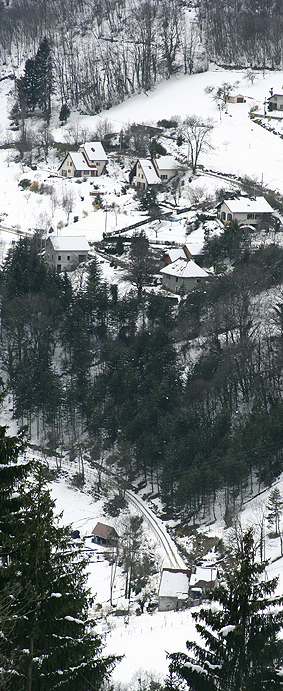
chinese-format-landscape.jpgWe went out to look for animal tracks in the snow, but we got a negative result.  All the animals are sensibly hiding in the woods.  So, we made a few tracks of our own, sledge tracks, snow angels, paths trudged everywhere and ergonomically designed snow chairs at the sunset spot where we stopped to admire the view.  Anyone can tell that humans were here.

I tried to do a Chinese format landscape of the houses across the valley from us.

Calculator math

Tuesday, March 25th, 2008

I wouldn’t have thought of introducing calculators to Antonia yet but it’s part of the math program we’re using, so we did it for the sake of completeness.  I suppose I shouldn’t be surprised that it turned out to be slower and less accurate than getting the answers by working them out on paper.  So I suppose there are skills being learned here!  Like remembering the string of characters you’re supposed to type into the machine and making sure that they were all registered.

It’s funny how these exercises often don’t develop the skills they nominally appear to be developing – though I wasn’t sure till now, what skills calculators do develop.  We also did a bit of map work with grid referencing.  Finding the references was easy.  The observation skills needed to find the objects we were supposed to be referencing in a small map… not so much.

The chimpanzee genome project is pretty cool, actually

Tuesday, March 25th, 2008

These people said:

“Evolution “cannot be subjected to a test” because it is something that supposedly occurred in the past and is not occurring today. And before you jump all over that, natural selection (changes within a species that are occurring at present) is not evolution, and there is no recorded instance of a new form or function being observed to have developed through natural means.”

I thought I would jump all over them.  Even though I wasn’t smart enough to figure out how to leave a comment at their blog, I can understand this one.  People who expect to see radical visible changes in organisms in a handful of human generations, e.g. since we discovered evolution, are missing something.  A grip on timescales possibly?

Approximately 500,000 generations (about 250,000 each, from our common ancestor) are estimated to separate us from chimpanzees, our closest relatives, a process that took about 6 million years.  Whether this has produced significant differences in form or function is bound to be a subjective judgement. So check out the chimpanzee genome sequencing project, for something a bit more precise.  Wikipedia gives quite a nice summary, and there’s about a million other things on the net.  It’s a fun thing to research and it underlines the fact that a grasp of genetics is absolutely essential to anybody hoping to understand evolution.

Personally, I’m impressed by just how many genes have changed in so short a time, how few of the changes are visible, and how few changes you need to create visible differences (like chihuahuas from wolves).

For evolution happening today, see here.  It mostly concerns nasty little things like resistance in organisms we can’t see and would rather be without. So as well as getting a grip on large time scales, you need to get familiar with small spatial ones, and with processes as well as morphology.

For the rest of this little discussion, see here and here. I have to go and teach my kiddie something before lunchtime now.